

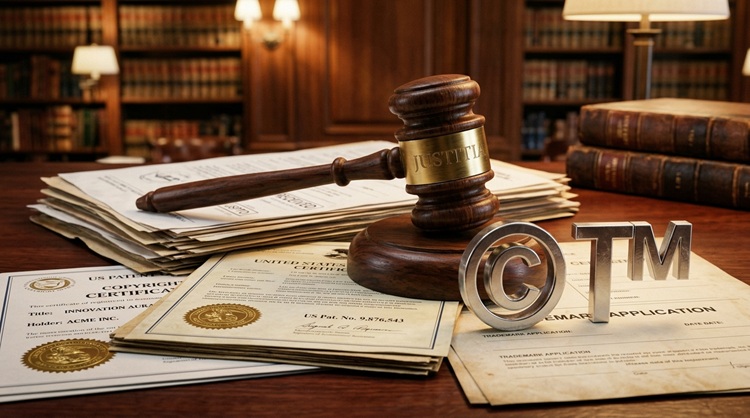
Every business creates intellectual property. A product design, a brand identity, software code, a marketing slogan, a proprietary process, a customer database: these are assets that may be more valuable than the business’s physical equipment or inventory. Intellectual property law provides the tools to protect these assets, to prevent competitors from using them without permission, and to monetize them through licensing and transfer.
Understanding the different categories of intellectual property protection, what each covers, and how to obtain and enforce protection is essential for any business that takes its brand, its products, or its creative output seriously.
At shaked-law-firm.com you will find a legal information blog covering intellectual property law, commercial law, and practical legal guidance for businesses and entrepreneurs protecting their assets.
Table of Contents
Trademarks: Protecting Brand Identity
A trademark is a sign that distinguishes the goods or services of one business from those of others. It can be a word, a logo, a color, a sound, or any other distinctive sign. Trademark registration gives the owner the exclusive right to use the registered mark in connection with the goods or services for which it is registered, and the right to prevent others from using confusingly similar marks.
Trademark protection is primarily territorial: a registration in one country does not automatically protect the mark in another. International frameworks (the Madrid System administered by WIPO) allow trademark owners to seek protection in multiple countries through a single application, but registration is still granted or refused country by country.
The strength of a trademark reflects its distinctiveness. Invented words (Kodak, Xerox) are the strongest category of trademarks because they have no descriptive meaning that others need to use. Generic words describing the product (a trademark application for “Coffee” for coffee) cannot be registered. Descriptive marks (terms that describe a characteristic of the product) occupy an intermediate position and may be registerable if they have acquired distinctiveness through use.
Trademark registration should be sought before the mark is widely used, because prior use by another party creates grounds for opposition. Conducting a clearance search before adopting a new brand name or logo identifies potential conflicts before the business has invested heavily in the mark.
Patents: Protecting Technical Innovation
A patent grants the inventor an exclusive right to use a technical invention for a defined period (typically 20 years from the filing date) in exchange for publicly disclosing the invention. The patent system is designed to incentivize innovation by providing a temporary monopoly that allows inventors to recoup their investment, while ensuring the knowledge enters the public domain when the patent expires.
To be patentable, an invention must be new (not previously disclosed anywhere in the world), involve an inventive step (not obvious to a person skilled in the field), and be capable of industrial application. Software, mathematical methods, and business methods have variable patentability depending on the jurisdiction: the approach in the United States differs from that in Europe.
Patent protection is territorial and more expensive to obtain and maintain than trademark protection. A patent application must be filed in each country where protection is sought, though the Patent Cooperation Treaty (PCT) streamlines the process of seeking protection in multiple countries. Given the costs, businesses typically prioritize patent protection in their most significant markets.
Copyright: Protecting Creative Works
Copyright protects original creative works from reproduction, distribution, public performance, and the creation of derivative works without the copyright owner’s permission. It arises automatically on creation of an eligible work, without registration. Literary works, music, art, photographs, software code, film, and databases all attract copyright protection.
The duration of copyright varies by jurisdiction and by type of work, but is generally the life of the creator plus 50 to 70 years. For works created by employees in the course of employment, the employer typically owns the copyright. For commissioned works, the legal position varies: in some jurisdictions, the commissioner owns the copyright; in others, the creator retains it unless there is a contract transferring it.
Copyright does not protect ideas, only their expression. The idea for a mystery novel cannot be protected; the specific text of a mystery novel is protected as soon as it is written. This means that copyright provides less protection in fields where ideas are the primary value than in fields where specific expression is the valuable asset.
Trade Secrets and Confidential Information
Not all valuable business information is protected by registered intellectual property. A formula, a customer list, a manufacturing process, or a business method that is kept secret and provides a competitive advantage may be protected as a trade secret even without registration.
Trade secret protection requires that the information actually be kept secret (through access controls, confidentiality agreements, and employee training) and that steps be taken to maintain that secrecy. Information that is publicly available cannot be protected as a trade secret. When an employee or contractor misappropriates a trade secret, a legal remedy may be available even in the absence of patent or copyright protection.
Confidentiality agreements (non-disclosure agreements, NDAs) are the primary contractual mechanism for protecting information shared in commercial contexts. A well-drafted NDA defines what is confidential, how it may be used, how it must be protected, and what happens if it is disclosed in breach of the agreement.
Enforcing Intellectual Property Rights
Intellectual property rights are only as valuable as the willingness and ability to enforce them. Registration provides the legal foundation for enforcement, but enforcement requires active monitoring for infringement and a willingness to take action when infringement is found.
Cease and desist letters are the first step in most IP enforcement situations: formally putting the infringer on notice and demanding that the infringing activity stop. Many infringements resolve at this stage without litigation.
Where litigation is necessary, the remedies available typically include injunctive relief (a court order requiring the infringer to stop), damages (compensation for losses caused by the infringement), account of profits (requiring the infringer to pay over the profits made from the infringement), and in some jurisdictions, criminal penalties for deliberate infringement.