

Table of Contents
A Practical Framework for Tooth Size
Spur gears appear simple at a glance. A round blank. Evenly spaced teeth. Straight profile. Yet the performance of any spur gear set depends entirely on precise tooth geometry. If the tooth size is misdefined or mismatched, the result is noise, premature wear, or complete meshing failure.
Two systems define tooth size in spur gears: diametral pitch and module. They describe the same physical relationship, but through different measurement standards. For engineers, buyers, and machinists working across global supply chains, understanding both is essential.
Diametral Pitch: The Inch-Based Standard
Diametral pitch, or DP, defines the number of teeth per inch of pitch diameter. The formula is straightforward:
Diametral Pitch = Number of Teeth ÷ Pitch Diameter (in inches)
If a gear has 20 teeth and a 2-inch pitch diameter, its DP is 10. A higher DP means smaller teeth. A lower DP means larger teeth.
This system remains common in North American mechanical design. Many legacy gearboxes, conveyors, and industrial drives were designed using inch-based standards, so replacement components must match.
From a manufacturing standpoint, DP affects cutter selection, inspection gauges, and machine setup. Gear hobs and shaping cutters are produced specifically for DP values. A 16 DP cutter generates a very different tooth form than an 8 DP cutter. There is no flexibility there. The geometry is fixed.
In high DP gears such as 48 or 96 DP, tooth size becomes fine and delicate. These are common in instrumentation or precision motion systems. Lower DP values such as 2 or 4 are typically used in heavy-duty applications where torque transmission matters more than compact size.
Module: The Metric Measurement
Module serves the same purpose as diametral pitch, but it expresses tooth size in metric units. The formula is:
Module = Pitch Diameter (mm) ÷ Number of Teeth
Higher module values indicate larger teeth. Lower module values indicate smaller teeth.
Unlike DP, which feels like a ratio, module reflects actual tooth scale in millimeters. For engineers working in metric systems, this often simplifies design integration with shafts, bearings, and housings.
Module dominates in European and Asian manufacturing environments. Many global OEMs specify module exclusively, which means suppliers must support both systems without hesitation.
The mathematical relationship between the two is simple:
Module = 25.4 ÷ Diametral Pitch
Diametral Pitch = 25.4 ÷ Module
The constant 25.4 represents the number of millimeters in one inch. However, conversions rarely result in clean, standard values. For example, an 8 DP gear converts to 3.175 module. That number does not correspond to a preferred module size like 3 or 3.5 mm. Because of this, direct substitution is not practical. A DP gear must mesh with DP. A module gear must mesh with module.
Why Both Systems Continue to Exist
The coexistence of diametral pitch and module is historical rather than technical. American industrial growth developed around inch-based measurements. Europe and much of the rest of the world standardized on metric.
Tooling inventories, inspection standards, and design databases evolved around each system. Changing entirely to one universal standard would require widespread redesign and retooling across multiple industries. That transition has never fully occurred.
As a result, gear manufacturers serving global markets must remain fluent in both languages.
Manufacturing Implications for Spur Gears
The choice between diametral pitch and module directly affects production strategy. Hobbing tools, shaping cutters, and inspection equipment are system-specific. A DP hob cannot produce a true module tooth form.
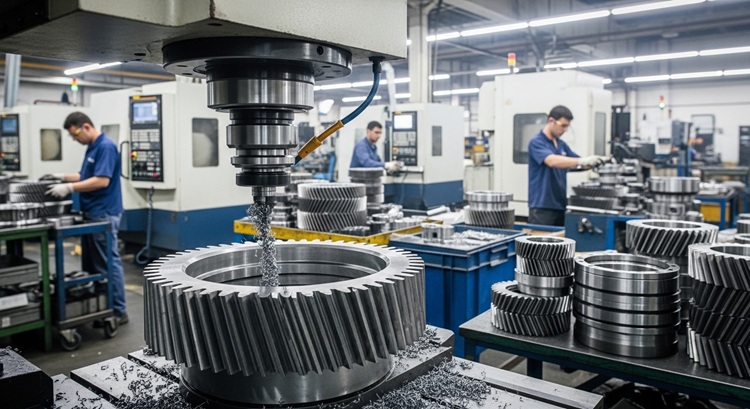
External spur gears are typically cut using hobbing or shaping, depending on geometry and quantity. Diameters may range from small fractional inches up to 25 inches or more. Face width also varies significantly, especially in hobbed gears where longer lengths are possible.
Internal spur gears present additional constraints. Because teeth are cut along the inside diameter, shaping operations limit face width and require careful tool access planning. Tooth size selection becomes even more critical in internal applications, where clearance and chip evacuation are more demanding.
Material choice further influences the process. Brass and bronze machine cleanly but require attention to burr control. Aluminum dissipates heat rapidly. Cast iron provides rigidity but demands dust management. Hardened steels increase tool wear and demand precise parameter control. Plastics introduce deflection concerns, especially in fine-pitch gears.
Tooth size interacts with all of these variables. Fine DP or low module gears demand tighter tolerances and careful inspection. Coarser gears require higher cutting forces and more rigid setups. The design decision ripples through the entire manufacturing workflow.
Internal and External Spur Gears in Practice
Whether the gear is internal or external, the governing tooth system must match the mating gear exactly. There is no compromise in meshing geometry.
As an example, a custom spur gear manufacturer such as Precision Gears, Inc. supports both diametral pitch and module specifications across a broad size range. Capabilities extend from fine 96 DP gears to large 2 DP components, as well as module sizes from 0.25 up to 12. Such flexibility allows compatibility with domestic equipment as well as international assemblies.
This dual capability is increasingly important as supply chains span continents and design teams collaborate across time zones.
Selecting the Appropriate Standard
The decision between diametral pitch and module typically depends on the larger system context.
If the application integrates with existing inch-based equipment, diametral pitch maintains compatibility. If the system is fully metric or destined for international markets, module provides consistency.
The critical factor is uniformity. All gears within a mesh must share the same standard. Mixing systems within a gearbox is not feasible without redesign.
Clear specification early in the design phase prevents costly delays. Confirming whether a drawing calls for DP or module may seem minor, yet that single clarification determines tooling, inspection method, and production scheduling.
Final Thoughts
Diametral pitch and module are two measurement systems describing the same geometric relationship. Their differences are rooted in unit conventions, not mechanical function.
For engineers and manufacturers, understanding both systems ensures accurate communication and reliable performance. In spur gear design, small numerical distinctions carry large mechanical consequences. Precision in specification leads directly to precision in motion.